






Ladder Game
Draw a ladder for everyone and follow each line down to a penalty or prize. Every outcome is equally likely, wherever you stand.
Loading…
How to use
- Tap the list above the game and type the players' names.
- Under Results, add penalties or prizes. "Pass*3" adds three, and an empty spot is a pass.
- Tap a name to send that person down, or Show result to reveal everyone at once.
Ladder game rules
Each player takes one of the vertical lines at the top of the ladder. Follow your line down, and whenever you reach a rung, cross it to the next line and carry on down. The spot where you come out at the bottom is your result.
A rung always joins two neighboring lines, so two players never end up in the same place: everyone gets exactly one result, and every result goes to someone. That is why a ladder game can hand out penalties, prizes or turns.
When to use a ladder game
Whenever a group needs to share out different outcomes by chance:
- Deciding who buys the coffee or pays for lunch
- Taking turns: who presents first, who goes next
- Sharing out chores, duties or a cleaning rota
- Assigning seats, rooms or teams
- Giving out prizes and blanks at a party
Is a hand-drawn ladder fair?
Not quite. A rung moves a player only one line sideways, so on a paper ladder players tend to finish near the line they started on, and the results right below them come up more often than those at the far end. More rungs even out the odds only slowly: with five players, it takes roughly a hundred rungs before every result is about equally likely.
This ladder picks the outcome first, with the browser's cryptographic random generator, then draws rungs that lead there, so every result is equally likely from any spot.
Ladder game origin: amidakuji and ghost leg
In Japan, where it goes back to the Muromachi period (1336–1573), the game is called amidakuji. It was first drawn as lines spreading out from a center, which looked like the halo of Amida Buddha, hence the name. In Korea it is sadaritagi, "ladder riding", and in Chinese huà guǐ jiǎo, "drawing ghost legs", which gave the game its English name, ghost leg.
Frequently asked questions
Is the ladder game fair, or can it be rigged?
Results are decided with the browser's cryptographic random generator before the start, and the ladder is drawn so every result is equally likely from any spot. The rungs stay hidden until the start.
Can I share the ladder game result in a group chat?
Yes. Copy the result as text with the game, the time and the link, or send it straight from the Share button on a phone.
More in Random Games

Flip a coin for heads or tails. The coin stands on its edge, spins like a top and falls on the side drawn before the spin, so heads and tails are exactly 50/50.
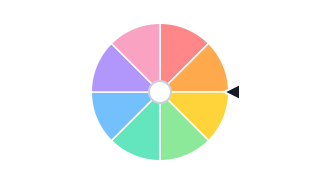
Make a custom wheel from names or your own items, such as penalties or lunch spots, and spin it to land on one at random. Every slice is equally likely.
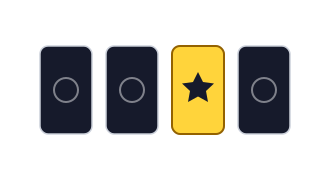
Pick a name: shuffle the cards and turn them over one by one, with names, your own prizes and blanks, or numbers. Draw first or last, the odds are the same.
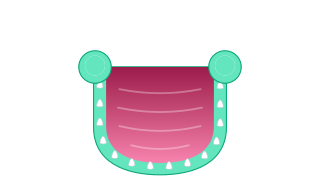
Take turns pulling the crocodile's teeth until one bites. The biting tooth is drawn before the first pull, so everyone has the same chance of being caught.
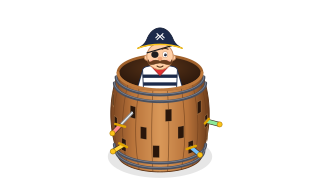
Take turns pushing swords into the barrel until one launches the pirate. That slot is drawn before the first sword, so everyone has the same chance.
Tap or shake your phone and 3D dice tumble across the table: a D6, D20, D100 or any number of sides, up to six at once with the total. For game night or D&D.
A marble for each name races down a 3D trap tower; the order they finish picks a winner, a ranking or teams. A ranking's deciding marble ends in slow motion.
Split a list of names into random teams of even size, member by member or all at once.