





Dice Roller
Tap or shake your phone and 3D dice tumble across the table: a D6, D20, D100 or any number of sides, up to six at once with the total. For game night or D&D.
Loading…
How to use
- Pick the dice: D4, D6, D8, D10, D12, D20 or D100, or Other for any number of sides from 2 to 100.
- Choose how many to roll: 1 to 6 dice. Two six-sided dice are ready to go.
- Tap the board, or shake your phone, to throw. Hold the board to shake the dice in your hand first.
- Read each die and the total under the board. A D100 is two ten-sided dice, tens and units.
Dice probability with two dice
Two dice can land in 36 equally likely ways (6 × 6), but the totals are not equally likely. A 7 can be made six ways (1 and 6, 2 and 5, 3 and 4, each either way round), so it comes up 1 time in 6, while 2 and 12 can each be made only one way. A double, both dice the same, also comes up 1 time in 6.
- 2 or 12: 1 in 36
- 3 or 11: 2 in 36 (1 in 18)
- 4 or 10: 3 in 36 (1 in 12)
- 5 or 9: 4 in 36 (1 in 9)
- 6 or 8: 5 in 36
- 7: 6 in 36 (1 in 6)
With three dice there are 216 combinations, and 10 and 11 are the most likely totals, 27 ways each (1 in 8). The more dice, the more the totals bunch up around the middle.
Sides of a dice: opposite faces add up to 7
On a standard six-sided die, opposite faces traditionally add up to seven: 1 is opposite 6, 2 opposite 5, and 3 opposite 4. So the top and bottom of a die at rest always make 7, and since opposite faces never meet, the three faces seen at a corner always show one number from each pair. The dice here follow the same rule.
On Asian-style dice the one is colored red, and on some the four as well.
Dice with more sides: D4, D8, D10, D12, D20 and D100
Tabletop role-playing games such as Dungeons & Dragons use a set of seven dice, each named by a D and its number of sides. Five are Platonic solids, whose faces are all the same regular polygon; the ten-sided die is a pentagonal trapezohedron, ten kite-shaped faces meeting at two points. On a fair die every face comes up as often, so the average roll is the number of sides plus one, halved:
- D4, a tetrahedron of four triangles: small damage, such as a dagger's. Average 2.5
- D6, a cube: board games, and damage in many games. Average 3.5
- D8, an octahedron of eight triangles: a longsword's damage. Average 4.5
- D10, a pentagonal trapezohedron: damage, and percentages in pairs. Average 5.5
- D12, a dodecahedron of twelve pentagons: a greataxe's damage. Average 6.5
- D20, an icosahedron of twenty triangles: attack rolls, ability checks and saving throws in D&D. Average 10.5
- D100, two ten-sided dice: percentile tables, and skill rolls in Call of Cthulhu. Average 50.5
A D4 has no face on top, so most are read by the number at the top point: each face carries three numbers, one by each corner. A D100 is two ten-sided dice, one marked 00 to 90 for the tens and one 0 to 9 for the units, read together: 40 and 7 make 47, and 00 and 0 make 100. Many ten-sided dice are numbered 0 to 9, the 0 counting as 10; the one here is numbered 1 to 10. On most dice, opposite faces add up to one more than the number of sides (21 on a D20), as they do here.
An odd number of sides is usually made with a die of twice as many faces, each number on it twice: a D3 is a cube with 1 to 3 twice, a D5 a ten-sided die with 1 to 5 twice. Here a D7 is a 14-sided die with 1 to 7 twice, and a number with no die of its own, such as 37, is read from a pair of ten-sided dice that only ever shows 1 to 37.
Dice history and origin
Dice are among the oldest gaming tools. They are thought to have grown out of fortune-telling with knucklebones, the ankle bones of animals. Bone dice from Skara Brae in Scotland date from 3100–2400 BCE, and dice from the Burnt City in south-eastern Iran from 2800–2500 BCE. In Korea, a 14-sided die from the Unified Silla period, the juryeonggu, was found at Donggung Palace and Wolji Pond in Gyeongju; the words on its faces are thought to be penalties in a drinking game. Its 14 faces are 6 squares and 8 hexagons, unlike the 14-sided die thrown here for a D7, a trapezohedron of 14 kite-shaped faces.
Frequently asked questions
Can I roll a D20 online?
Yes. Pick D20, and a 3D icosahedron numbered 1 to 20 is thrown and read by the face on top. Roll one, or two at once for advantage, and each value shows under the board.
How do you roll and read a D100?
Pick D100, and two ten-sided dice are thrown: one for the tens (00 to 90) and one for the units (0 to 9), read together, so 40 and 7 make 47. 00 and 0 make 100.
Can I roll 2 dice at once?
Yes. Two six-sided dice are where it starts, and you can roll 1 to 6 dice of one kind at once and see the total. When all of them match, it says so.
How can a 7-sided die be fair?
A D7 is thrown as a 14-sided die with 1 to 7 on it twice each, so every number comes up equally often. Other odd numbers work the same way: a D3 is a cube with 1 to 3 twice, a D5 a ten-sided die with 1 to 5 twice.
Can I roll a die with any number of sides?
Yes, any whole number from 2 to 100 under Other. A number with no die of its own, such as 37, is a pair of ten-sided dice read as tens and units that only ever shows 1 to 37, each equally likely.
Is the dice roller fair?
Yes. Each value is drawn with the browser's cryptographic random generator before the throw, every number equally likely. The 3D throw only shows the result.
Does it work in every browser?
It needs WebGL 2, which draws the dice in 3D. Recent Chrome, Edge, Firefox and Samsung Internet have it, and Safari from version 15. Where it is missing (an old browser or device, hardware acceleration turned off, or WebGL blocked), the page says so instead of the game; the coin flip, ladder game and crocodile teeth game work without it.
More in Random Games

Flip a coin for heads or tails. The coin stands on its edge, spins like a top and falls on the side drawn before the spin, so heads and tails are exactly 50/50.
Draw a ladder for everyone and follow each line down to a penalty or prize. Every outcome is equally likely, wherever you stand.
Make a custom wheel from names or your own items, such as penalties or lunch spots, and spin it to land on one at random. Every slice is equally likely.
Pick a name: shuffle the cards and turn them over one by one, with names, your own prizes and blanks, or numbers. Draw first or last, the odds are the same.
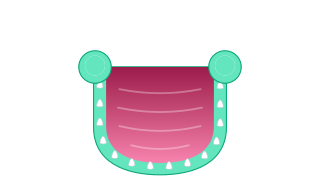
Take turns pulling the crocodile's teeth until one bites. The biting tooth is drawn before the first pull, so everyone has the same chance of being caught.
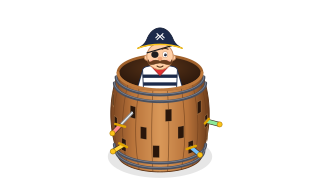
Take turns pushing swords into the barrel until one launches the pirate. That slot is drawn before the first sword, so everyone has the same chance.
A marble for each name races down a 3D trap tower; the order they finish picks a winner, a ranking or teams. A ranking's deciding marble ends in slow motion.
Split a list of names into random teams of even size, member by member or all at once.