






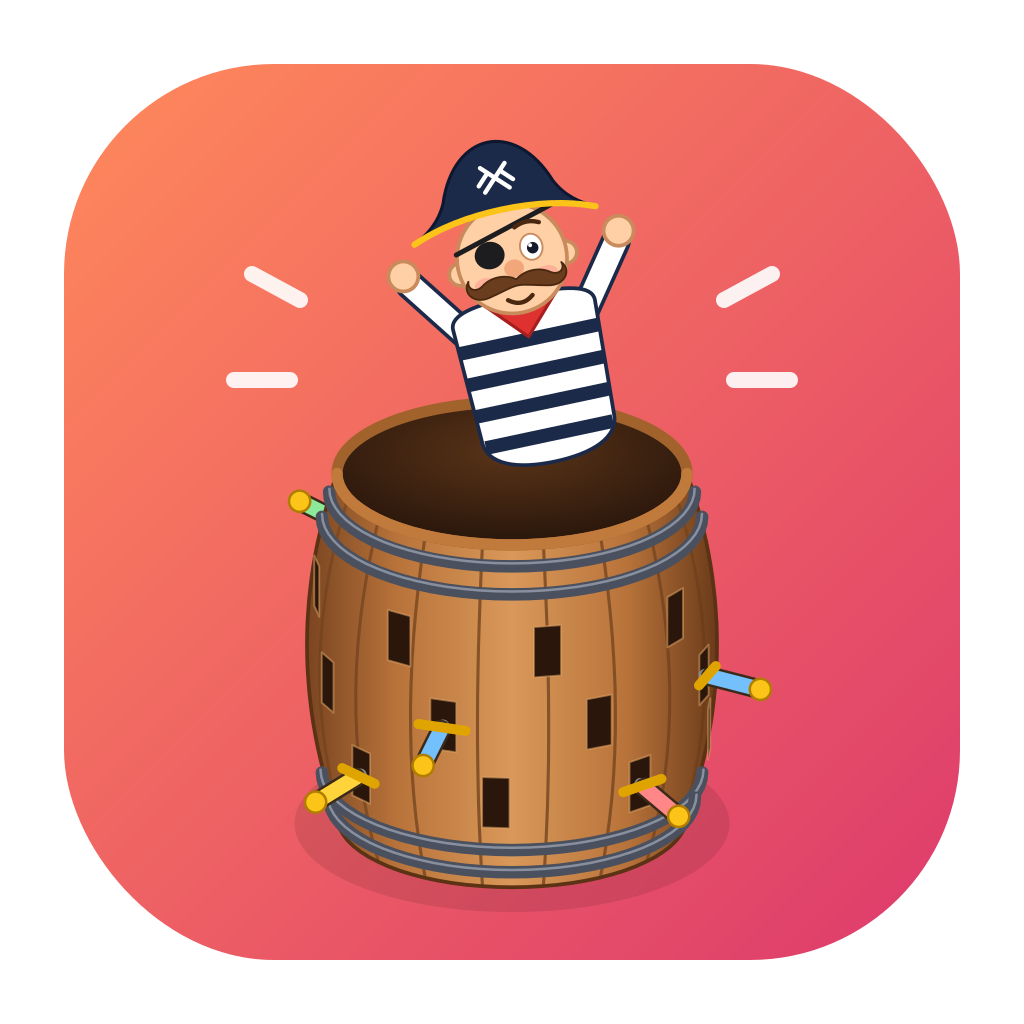
Pirate Barrel Game
Take turns pushing swords into the barrel until one launches the pirate. That slot is drawn before the first sword, so everyone has the same chance.
Loading…
How to use
- Type the players' names and choose how many slots the barrel has.
- Drag the barrel to turn it, then hold a slot for 1 second to push a sword in.
- Whoever launches the pirate is caught. Put him back in the barrel for a new round.
Pirate barrel game rules
A pirate sits in a barrel full of slots. Players take turns pushing a sword into one slot each. One of the slots launches the pirate: whoever pushes its sword in sends him flying out of the barrel, and takes the penalty, pays for the coffee or goes first, whatever the group agreed.
Drag the barrel sideways to turn it and pick a slot. Then hold the slot down for a second: the sword slides in while you hold it, and if you let go sooner it slides back out and nothing happens. Once it is in, the pirate stays put, jumps in his barrel or flies out.
When every slot but one has a sword, the last one is the slot that launches him, so its sword goes in by itself on whoever's turn it is.
Why the number of slots matters
Which slot launches the pirate is drawn before the first sword, every slot as likely as any other. What can still be unfair is how the turns share out: with 13 slots and four players, the first player gets a fourth turn that the others never get, and a 4 in 13 chance of launching him instead of 1 in 4.
So here the number of slots is always a multiple of the number of players, and the first player is drawn at random: everyone gets as many turns, and everyone launches the pirate 1 time in the number of players. A pause, or the pirate jumping in his barrel after a sword, is drawn on its own and gives nothing away.
When to play the pirate barrel game
Whenever a group needs one person picked, with some suspense on the way:
- Who pays for coffee or lunch
- A penalty or a forfeit at a party
- Who goes first, or who does the chore
- A tense round on a big screen in class or at the office
- A quick game with children
Frequently asked questions
Is the pirate barrel game fair?
Yes. The slot that launches the pirate is drawn with the browser's cryptographic random generator before the first sword, and the number of slots always shares out evenly between the players, so everyone gets as many turns and the same chance of launching him.
Is there a way to win the pirate barrel game?
No. Any slot is as likely as any other to launch him, and going first, last or in between gives the same chance of being caught. A pause after a sword, or the pirate jumping in his barrel, gives nothing away either: it is drawn on its own, apart from the launching slot.
Why do I have to hold a slot for a second?
The sword slides in while you hold the slot, so the suspense builds and a slip of the finger does nothing: let go before a second is up and it slides back out. From the keyboard, Enter or Space on a slot pushes the sword in by itself.
More in Random Games

Flip a coin for heads or tails. The coin stands on its edge, spins like a top and falls on the side drawn before the spin, so heads and tails are exactly 50/50.
Draw a ladder for everyone and follow each line down to a penalty or prize. Every outcome is equally likely, wherever you stand.
Make a custom wheel from names or your own items, such as penalties or lunch spots, and spin it to land on one at random. Every slice is equally likely.

Pick a name: shuffle the cards and turn them over one by one, with names, your own prizes and blanks, or numbers. Draw first or last, the odds are the same.
Take turns pulling the crocodile's teeth until one bites. The biting tooth is drawn before the first pull, so everyone has the same chance of being caught.
Tap or shake your phone and 3D dice tumble across the table: a D6, D20, D100 or any number of sides, up to six at once with the total. For game night or D&D.

A marble for each name races down a 3D trap tower; the order they finish picks a winner, a ranking or teams. A ranking's deciding marble ends in slow motion.
Split a list of names into random teams of even size, member by member or all at once.